Inside a 7,000 m² Cable Factory in Shanghai
The published footprint is more than 7,000 m² in Jinshan District, Shanghai, with production facilities and laboratories at one address and a speciality cable laboratory that has been running since December 2015. KUKA CABLE is a solar cable manufacturer that also publishes its own milestones, and those pages describe the plant more usefully than a photograph does: a first factory in December 2012, an independent PV division from August 2018, a wire harness processing base added in June 2021 and a new factory completed in May 2023.
Key takeaways
- The manufacturer page gives the site as more than 7,000 m²; the company page shows a factory figure of 6,000 m², so the two numbers describe different slices of one address.
- The laboratory dates from December 2015 and is described as an ISO/IEC 17025 laboratory; nine test pages are published for it.
- Finished cable is described as fully inspected, not sampled: the published quality model has four stages ending in inspection and sample retention.
- The plant has been adding capacity steadily - a harness base in June 2021, national high-tech enterprise status in March 2023 and a completed new factory in May 2023 - while the company states it exports to more than 120 countries.
Two area figures, two different pages
The manufacturer page states a site of more than 7,000 m² covering production facilities and laboratories. The company page carries a separate figure of 6,000 m² under the word factory. Both are published by the same company, and they are best read as the whole site against the production hall alone rather than as a contradiction.
If the factory floor takes 6,000 m² of a site of more than 7,000 m², the remainder is roughly 1,000 m² for everything else the company lists at the address - the speciality cable laboratory, stores, offices and the areas a visitor walks through (this subtraction is my own arithmetic, and it assumes both figures describe the same site). The published pages do not break the site down area by area, so treat that as an illustration rather than a floor plan. For scale, 7,000 m² is about 0.7 hectares, which is my own conversion at 10,000 m² to the hectare.
The milestones the company publishes
A single timeline page tells the story of how the site grew. Read together, the dates describe a cable maker that expanded from a single production building into a site with its own laboratory and a separate photovoltaic business.
Two of the dates matter to a PV buyer more than the others: December 2015, when the speciality cable laboratory was established, and August 2018, when the PV division was made independent. The first is the reason test data exists on paper rather than as a claim. The second is the reason the solar range has its own product pages, models and certificates rather than sitting in a general catalogue.
- August 2012: company founded.
- December 2012: first factory built.
- December 2015: speciality cable laboratory established.
- August 2018: PV division becomes independent.
- June 2021: wire harness processing base established.
- March 2023: recognised as a state-certified national high-tech enterprise.
- May 2023: new factory completed.
The laboratory and its published test list
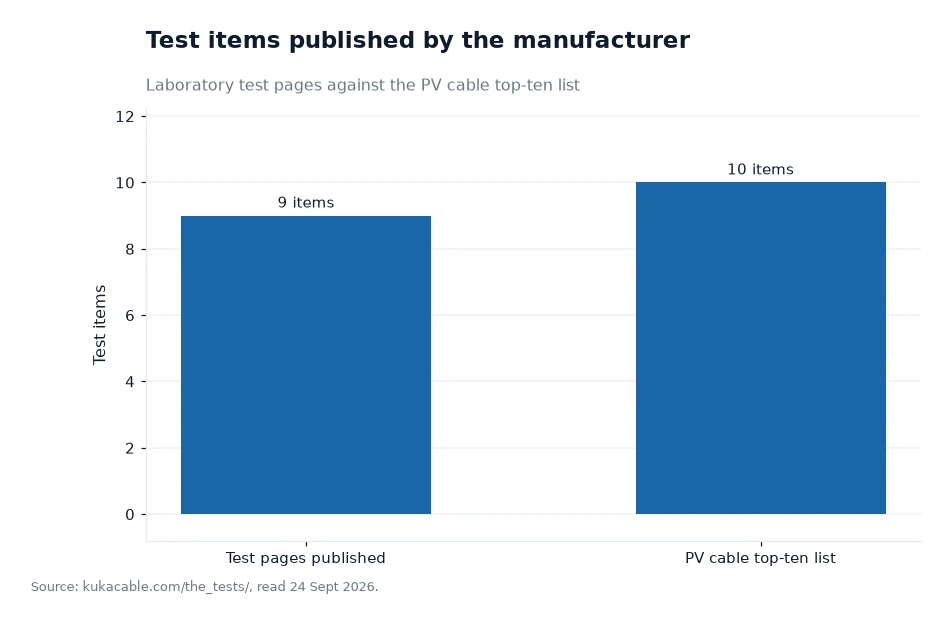
The laboratory section on the manufacturer's site publishes nine test pages: water resistance, UV accelerated weathering, cable abrasion, cold bending, cold elongation, tensile testing after ageing, solderability, static flexibility, and cable construction and dimensional testing. A separate ranked article, presented as a top-ten list of tests for PV cables, names conductor resistance, insulation resistance, dielectric strength, tensile strength, heat resistance, flame retardant performance, environmental adaptability, corrosion resistance and cable connectivity.
The site also publishes the shape of its weather testing: a 2,000-hour xenon lamp exposure described as equivalent to about 360 weathering cycles, arranged on the company's solar cables. Elongation at break is stated as typically reaching up to 185% against the 125% required by EN 50618, and the vertical flame test described for PV cables exposes a single cable to 800 °C for one minute and expects it to self-extinguish.
Inspection of every finished length
The quality model published on the site is described as going beyond what TUV certification covers, and it has four stages: raw materials tested against several international benchmarks, manufacturing monitored by digital control systems, full inspection of finished products for electrical, mechanical and environmental performance, and sample retention with traceability. The fourth stage is the one a buyer can use later, because a retained sample is what settles a dispute about a batch that has already been installed.
What the factory pages do not publish is equally worth noting. There is no annual output in kilometres, no headcount, no revenue and no customer list. A buyer who needs those figures has to ask the product consultant, and the request should be specific - capacity for the size in question, measured over a stated period - rather than a general question about how big the plant is.
| Date | Milestone published | Why it matters to a PV buyer |
|---|---|---|
| August 2012 | Company founded | The manufacturing background behind the solar range |
| December 2012 | First factory built | Start of in-house production rather than trade alone |
| December 2015 | Speciality cable laboratory established | Origin of the published test data |
| August 2018 | PV division becomes independent | Dedicated solar pages, models and certificates |
| June 2021 | Wire harness processing base established | Connector and harness work alongside cable |
| March 2023 | National high-tech enterprise recognition | State-certified status for the technical work |
| May 2023 | New factory completed | Additional production space at the same address |
Worked example
Take the two published area figures together. The whole site is given as more than 7,000 m² and the factory figure as 6,000 m², so the area outside the production hall is about 1,000 m² at most (7,000 minus 6,000 equals 1,000; my own subtraction, assuming both numbers describe the same address). For a plant that also lists a laboratory, stores and offices, that remainder is small but not trivial - it is roughly the size of a laboratory plus the rooms around it.
The laboratory's age can be worked out from the same published date. It was established in December 2015, and the pages quoted here were read on 24 September 2026, which is a little over ten years and nine months of operation (my own calculation from the published month and the read date). Ten years of retained test records is the practical asset here, because a buyer comparing two suppliers can ask for the test history of a size rather than a single sheet of values.
Frequently asked questions
What does the Shanghai factory publish about its size and its output?
The manufacturer page gives the site as more than 7,000 m² of production facilities and laboratories in Jinshan District, Shanghai, with a speciality cable laboratory established in December 2015 and a new factory completed in May 2023. Output figures, annual capacity in kilometres, staff numbers and revenue are not published anywhere on the site, so a buyer who needs them has to ask the product consultant for them in writing.
How many laboratory tests does the manufacturer publish?
Nine test pages are published on the laboratory section, covering water resistance, UV accelerated weathering, abrasion, cold bending, cold elongation, tensile strength after ageing, solderability, static flexibility, and construction plus dimensional testing. A separate ranked article on PV cable tests is published as a top-ten list and names nine individual tests inside it, from conductor resistance to cable connectivity, so the total of ten on that page refers to the list rather than to an extra test.
How to read a factory claim
Match every claim to the page that publishes it, ask for the test report covering the size you are buying, and request the dimensional table so a drum can be checked against the drawing when it arrives. A visit is the last step, and the published address for it is Building 15, No. 9655, Tingwei Highway, Tinglin Town, Jinshan District, Shanghai. The manufacturer also lists a free sample service and a product consultant, so material can be in hand before a purchase order is signed.
The 7,000 m² facility and the laboratory dates above are the manufacturer's own website disclosure, read through on 24 Sept 2026[1].